In today’s always-connected world, reliable indoor cellular coverage is no longer optional. From enterprises and hospitals to manufacturing plants, campuses, and public venues, organizations depend on seamless mobile connectivity for operations, safety, and digital transformation. This is where a DAS system—or Distributed Antenna System—plays a critical role.
But not all DAS systems are created equal.
In this guide, we’ll explain what a DAS system is, what it is not, how DAS technology evolved, and how the Nextivity CEL-FI QUATRA portfolio represents the most advanced, efficient, and flexible approach to modern in-building DAS design.
What Is a DAS System?
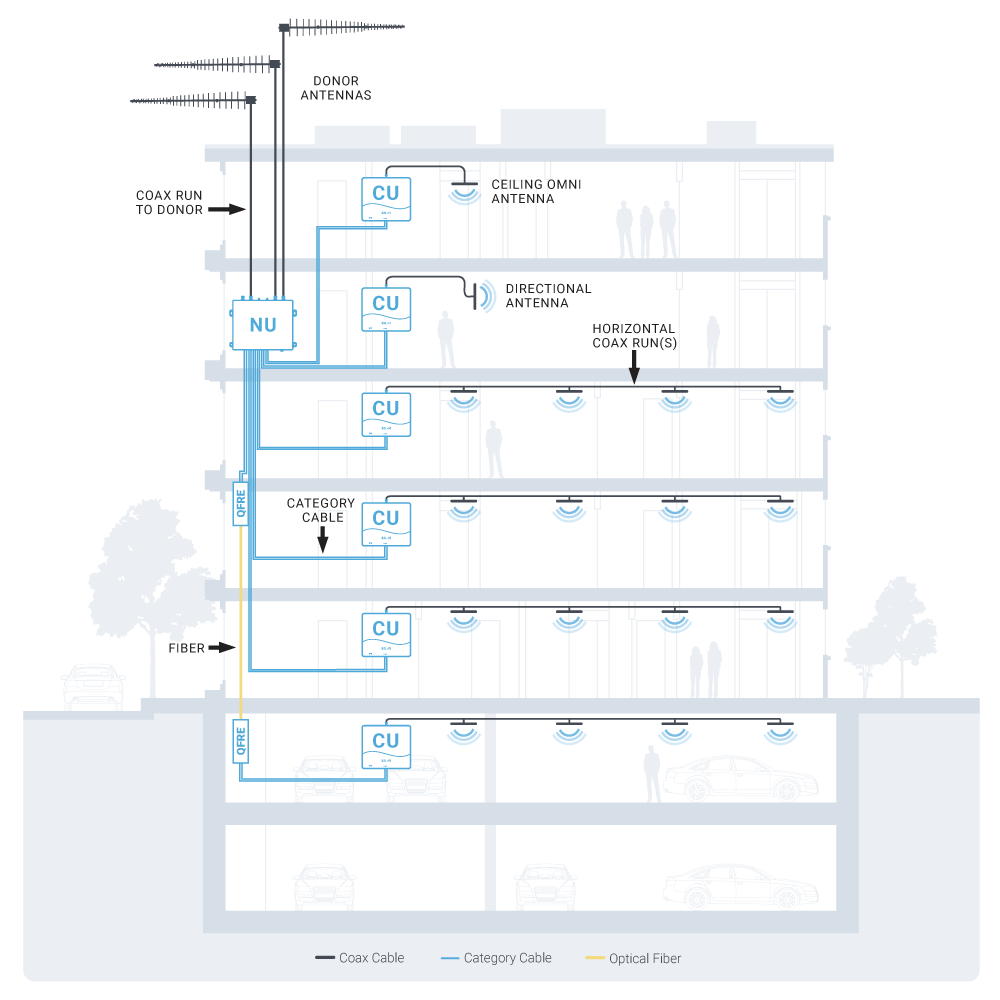
A DAS system (Distributed Antenna System) is a network of strategically placed antennas that distribute cellular signals throughout a building or campus. Rather than relying on macro cell towers to penetrate walls, concrete, and steel, a DAS brings cellular coverage inside, delivering consistent signal strength exactly where users need it.
At a high level, a DAS system:
- Captures signal from one or more cellular sources
- Conditions and amplifies that signal
- Distributes the amplified signal through a network of antennas
- Provides uniform indoor cellular coverage across large or complex spaces
DAS systems are commonly deployed in:
- Enterprise buildings and offices
- Hospitals and medical campuses
- Manufacturing and warehouse facilities
- Airports, stadiums, and convention centers
- Education campuses and public venues
A Brief History of DAS — and Nextivity’s Role in the Evolution of DAS
The earliest systems emerged decades ago in large venues like stadiums and airports, where traditional outdoor cellular signals could not meet capacity or coverage demands. These early systems were often passive DAS architectures, using coaxial cable and splitters to distribute signal with limited flexibility and significant signal loss.
As mobile usage exploded and buildings became more energy efficient, DAS evolved into active DAS systems, introducing fiber distribution, remote units, and centralized signal management. While powerful, these systems were also:
- Expensive to deploy
- Complex to design and maintain
- Dependent on specialized RF expertise
- Often overbuilt for many indoor environments
This complexity created a gap in the market—one that Nextivity set out to solve.
Nextivity pioneered a new category of digital, software-defined DAS, applying advanced signal processing, automation, and IntelliBoost® technology to dramatically simplify deployment while improving performance. The result is the CEL-FI QUATRA platform, redefining what a DAS system can be.
What a DAS System Is and Is Not
Understanding what qualifies as a true DAS system is critical when evaluating indoor cellular solutions.
A DAS system is:
- A purpose-built cellular distribution architecture
- Designed for large areas and complex environments
- Capable of supporting multiple antennas and sectors
- Engineered for consistent signal quality and capacity
- Optimized for operator-approved performance
A DAS system is not:
- A Wi-Fi network
- A small consumer signal booster
- A single repeater or hotspot
- A temporary coverage workaround
While Wi-Fi supports data connectivity, it does not provide native cellular voice, SMS, emergency services, or carrier mobility. Similarly, small boosters are effective for limited areas but lack the scalability, control, and performance required for enterprise-grade coverage.
A true DAS is a foundational piece of wireless infrastructure.
Why Modern Systems Demand a New Approach
Legacy DAS solved coverage problems—but often introduced new challenges:
- High capital and installation costs
- Long deployment timelines
- Difficult upgrades and expansions
- Underutilized capacity
- Manual RF tuning and balancing
As enterprises adopt IoT, Private LTE/5G, smart building technologies, and mobile-first workflows, DAS systems must become smarter, more scalable, and easier to manage. This shift requires more than traditional coverage—it demands the ability to Do More with DAS. That’s where Nextivity CEL-FI QUATRA DAS systems stand apart.
Why Nextivity CEL-FI QUATRA are the Most Effective Coverage DAS Systems
The CEL-FI QUATRA family represents a new generation of DAS—digital, intelligent, and software-defined.
Key advantages include:
Digital Signal Processing
Unlike analog systems, QUATRA uses advanced digital processing to preserve signal quality end-to-end. This results in:
- Higher signal integrity
- Improved uplink and downlink performance
- Consistent user experience across the building
Intelligent Power Management
QUATRA systems automatically manage signal levels, eliminating manual RF balancing and reducing interference risk.
Scalable Architecture
From a single floor to large campuses, QUATRA DAS systems scale easily by adding remote units and antennas without redesigning the entire system.
Operator-Approved Performance
Nextivity works directly with mobile network operators to ensure QUATRA systems meet carrier requirements—critical for enterprise reliability and long-term support.
Simplified Deployment
With fewer components, less cabling complexity, and software-driven configuration, (as compared to legscy DAS) QUATRA solutions dramatically reduce deployment time and cost compared to traditional DAS systems.
CEL-FI QUATRA for Every System Requirement
The Nextivity CEL-FI QUATRA portfolio supports a wide range of DAS system needs, including:
- Single-operator and multi-operator coverage
- LTE and 5G deployments
- Enterprise, healthcare, education, and industrial environments
- Private LTE and Private 5G architectures
By combining hardware innovation with intelligent software, CEL-FI QUATRA transforms DAS from a static RF system into a dynamic, future-ready wireless platform.
The Future of DAS Systems
As cellular becomes the backbone of digital operations, DAS will continue to evolve beyond coverage alone. Future DAS architectures must support:
- Higher device density
- Low-latency applications
- IoT and machine-to-machine communications
- Seamless integration with private networks
The Nextivity vision has always been to simplify complexity while maximizing performance—a philosophy embedded into every CEL-FI QUATRA DAS system deployed today.
Conclusion:
A DAS system is no longer just about filling coverage gaps—it’s about enabling modern enterprise connectivity.
By combining the proven principles of distributed antenna systems with digital intelligence, automation, and scalability, Nextivity CEL-FI QUATRA DAS systems deliver the most effective, efficient, and future-proof indoor cellular coverage available.
For organizations looking to build a reliable wireless foundation, the evolution of DAS has arrived.
Interesting Read: 2026 Predictions: How Wireless Experts See In-Building Connectivity Evolving