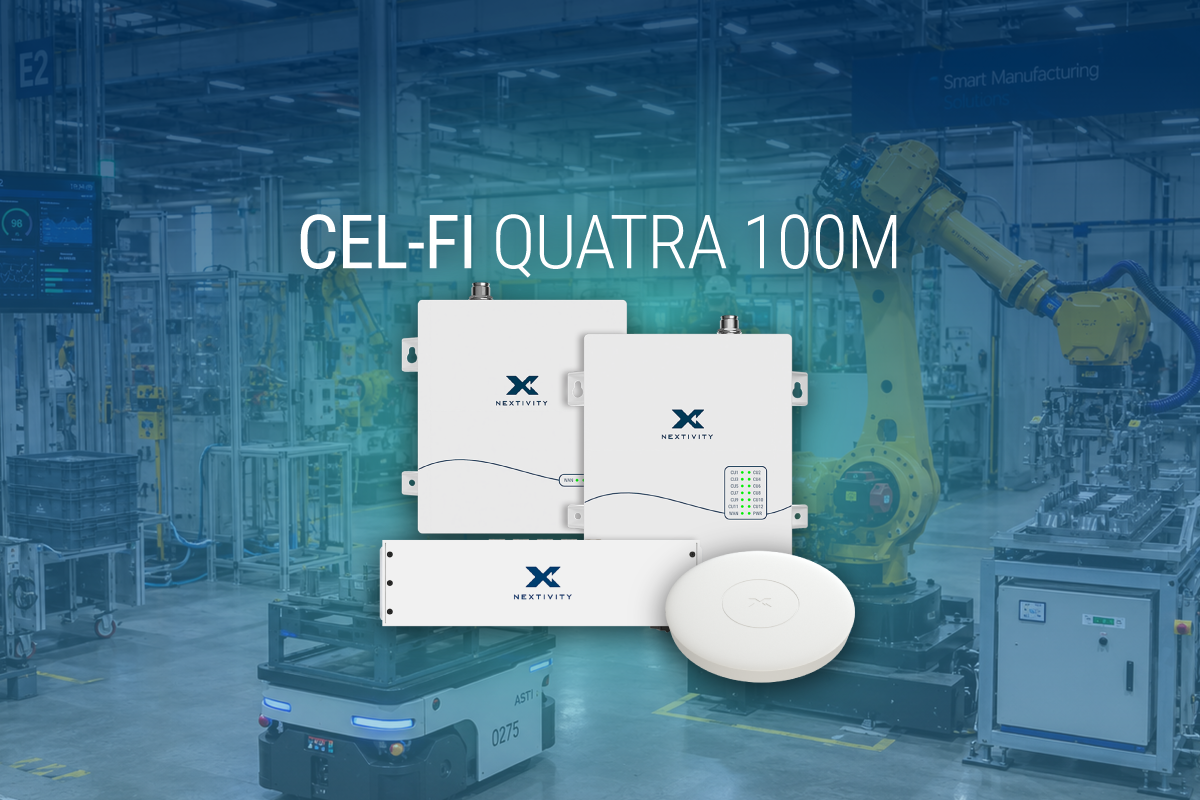

Manufacturing facilities are outgrowing traditional wireless strategies.
Modern manufacturing is becoming more automated, more data-driven and less tolerant of downtime. This increased automation, tighter safety expectations, real-time operational visibility and pressure to improve efficiency are all placing new demands on wireless connectivity and infrastructure, increasing the need for robust cellular coverage solutions. Yet many factories are still relying on wireless infrastructure that was never designed for moving machinery, metal-heavy environments or mission-critical operations where wireless signals struggle to travel reliably. In practice, this is creating a growing gap between what modern manufacturing operations need from wireless connectivity—including effective cellular coverage solutions—and what traditional solutions can reliably deliver.
A global manufacturing company tested Private 5G and compared it against Wi-Fi across their Autonomous Mobile Robots fleet in one factory location over an 8-week period. Over that period, Wi-Fi suffered over 6,000 seconds of missing location data which caused 29 bottleneck events (each bottleneck costing 10s of thousands of dollars). Over that same period, Private 5G suffered just 1 second of lost location data, meaning zero bottlenecks while delivering an immediate financial saving.
Why Manufacturing Is a Perfect Storm for Connectivity Challenges
Typical manufacturing facilities share several characteristics that make wireless reliability difficult and increase reliance on scalable indoor cellular coverage solutions:
- Large indoor spaces with metal machinery, racking and production lines
- High ceilings and changing layouts
- Mobile workers, contractors and visiting engineers
- Increasing use of automated moving equipment and robotics
- Safety-critical environments where communication failures carry real risk
Mobile operators prioritize stadiums and other large public venues where consumer density drives revenue. Manufacturing sites rarely meet that threshold, meaning mobile network operators are unlikely to invest in bespoke indoor coverage. At the same time, legacy in-building coverage systems are often costly, complicated to deploy, and take too long to roll out to be a practical option.
The result is an awkward middle ground: outdoor mobile signals struggle inside factories, but traditional indoor systems are too expensive to justify.
Wireless Connectivity Is No Longer “IT” – It’s Operational Infrastructure
In modern manufacturing, wireless connectivity underpins far more than email or internet access, with indoor cellular coverage playing a direct operational role.
It now directly determines:
- Worker safety and incident response
- Productivity and real-time communication
- Automation uptime and throughput
- Compliance, monitoring and reporting
- Business continuity and operational resilience
In this context, reliable cellular connectivity and well-designed manufacturing cellular coverage solutions are no longer convenient. They are becoming foundational operational infrastructure, on par with power, lighting, and physical safety systems.
Public Cellular: The Operational Baseline Manufacturers Often Overlook
DAS public cellular boosters are the first layer many facilities underestimate. In safety-critical environments, unreliable indoor coverage is not just frustrating—it becomes a compliance and liability exposure.
Inside factories, unreliable public cellular coverage leads to:
- Dropped calls and delayed incident response
- Failed scans and stalled workflows
- Lone-worker safety concerns
- Poor visitor and contractor connectivity
Smartphones and handheld devices are now the primary communication tools for supervisors, engineers and operators. When public cellular coverage fails inside a warehouse, productivity and safety are immediately impacted, reinforcing the need for dependable cellular coverage solutions.
An independent indoor cellular coverage approach allows manufacturers to:
- Improve coverage without relying on a single mobile operator
- Deploy quickly with minimal operational disruption
- Support all users, devices and carriers equally
Most importantly, public cellular boosters can solve today’s operational challenges while putting the right foundations in place for future applications through scalable manufacturing cellular coverage solutions.
Automation Is Exposing the Limits of Wi-Fi
Manufacturing automation is accelerating, increasing pressure on existing networks and driving demand for complementary in-building connectivity.
Autonomous vehicles, robotics, smart conveyors and mobile machinery all rely on consistent, predictable connectivity. Wi-Fi was designed for data access, not deterministic mobility. In high-metal environments with moving equipment and frequent layout changes, latency variability and roaming interruptions become unavoidable, as shown in the above example.
Common challenges for Wi-Fi include:
- Signal interference caused by heavy machinery, metal structures, and busy industrial environments
- Inconsistent delays that disrupt real-time operations
- Poor mobility and roaming performance
- Limited reliability for mission-critical systems
For manufacturing automations, lost wireless connectivity isn’t an inconvenience, it’s costly downtime.
Private 5G cellular connectivity for manufacturing provides a more predictable and reliable wireless connection, designed to support moving equipment, secure operations, and industrial automation, forming a critical part of modern cellular coverage solutions. Crucially, private cellular doesn’t need to replace Wi-Fi—it complements it, supporting the applications Wi-Fi cannot reliably handle.
Manufacturing Data Provides Continuous Insight with IoT
As factories add more connected systems and automation, supported by evolving cellular coverage solutions, understanding what’s happening in real time becomes critical. Moving from a reactive to a predictive maintenance strategy depends on reliable, persistent and deterministic connectivity across the site.
Many manufacturing environments still rely on:
- Manual inspections
- Paper logs
- Reactive maintenance
This creates blind spots around equipment health, environmental conditions, safety risks and asset location.
Low-power IoT sensors provide continuous monitoring in areas that are hard to access or supply with power, delivering:
- Early warning of equipment issues
- Improved safety and compliance monitoring
- Reduced spoilage, waste and unplanned downtime
- Real-time, data-driven decision making.
The key is scalability, deploying large numbers of sensors without redesigning the network each time, which is where flexible in-building connectivity adds long-term value.
The Business Case: Layered Value, Not Separate Networks
In many facilities, recovering just five minutes per worker per shift can equate to dozens of productive hours per week. Reducing automation stoppages or enabling predictive maintenance can shift connectivity from cost center to operational enabler within 12–24 months.
This equation can be further enhanced by deploying public cellular, private cellular and IoT as a single connectivity core through an integrated solution, enabling costs to reduce quickly, not only in hardware, but in design, minimized disruption and lower long term maintenance overheads.
Using one shared wireless infrastructure, rather than multiple separate networks, makes wireless connectivity far more effective over time.
- One infrastructure, multiple operational returns
- Faster deployment and lower total cost of ownership
- Phased investment aligned to budget cycles
- Clear expansion path as manufacturing needs evolve
Rather than treating connectivity as a series of isolated projects, manufacturers can design once and expand as requirements grow, using adaptable cellular coverage solutions.
Designing for the Factory of the Future
Manufacturing leaders don’t need to predict every future application to get wireless strategy right today, but they do need to evaluate their in-building connectivity.
They need to ask better questions:
- How critical is mobility to our operations?
- Where does downtime cost us the most?
- Which processes depend on real-time data?
- How easily can our wireless infrastructure scale?
Designing with flexibility in mind allows facilities to support today’s requirements, while remaining ready for tomorrow’s automation, analytics and safety demands through future-proof cellular coverage.
Connectivity as a Competitive Advantage
In manufacturing, wireless reliability increasingly defines operational performance.
Manufacturing facilities that treat connectivity as a core part of their operations, rather than just an IT task, gain:
- Safer working environments
- Higher productivity
- Greater automation confidence
- Faster digital transformation
The factories that win won’t necessarily be the most automated—they’ll be the ones with in-building connectivity that can support automation, mobility and real-time decision-making at scale without fragility.