
Modern buildings are more connected than ever, but having strong Wi-Fi does not necessarily mean a building is truly wirelessly ready.
In BICSI CALA 360 article Beyond Wi-Fi: The Wireless Readiness Gap in Modern Buildings, Paul Weintraub, General Director at Excigent, and Orlando Calderon, Sales Engineer for the Caribbean, Latin America, and Canada at Nextivity, examine why modern facilities increasingly need a broader wireless strategy that includes Wi-Fi, public cellular, private wireless, IoT, and public-safety communications.
The Wireless Readiness Gap
A building can have excellent Wi-Fi while occupants still experience dropped calls, unreliable mobile data, or cellular dead zones.
Part of the challenge comes from the buildings themselves. Low-emissivity glass, concrete, structural steel, dense interior construction, and below-grade spaces can weaken signals coming from outdoor cellular networks. Elevators, stairwells, parking structures, mechanical rooms, and deep interior spaces are especially common problem areas.
The result is what the authors describe as a wireless readiness gap: a facility may appear well connected because Wi-Fi is available, while cellular and other critical communications needs remain unaddressed.
Wi-Fi and Cellular Serve Different Purposes
Wi-Fi remains an essential part of modern building infrastructure. It supports enterprise LAN access, guest connectivity, collaboration tools, managed devices, and many IoT applications. But it represents only one layer of the wireless environment.
Public cellular provides native voice, messaging, and mobile data without requiring visitors, employees, contractors, or customers to connect to the building’s network. Reliable cellular coverage also supports mobility as users move through offices, corridors, elevators, parking structures, and other areas where outdoor signals may struggle to penetrate.
Private LTE and 5G can add another layer, supporting dedicated operational, industrial, campus, and controlled applications, while IoT networks can enable sensing, automation, and monitoring. Rather than selecting one wireless technology over another, the authors recommend starting with a more fundamental question:
What does the building need to support?
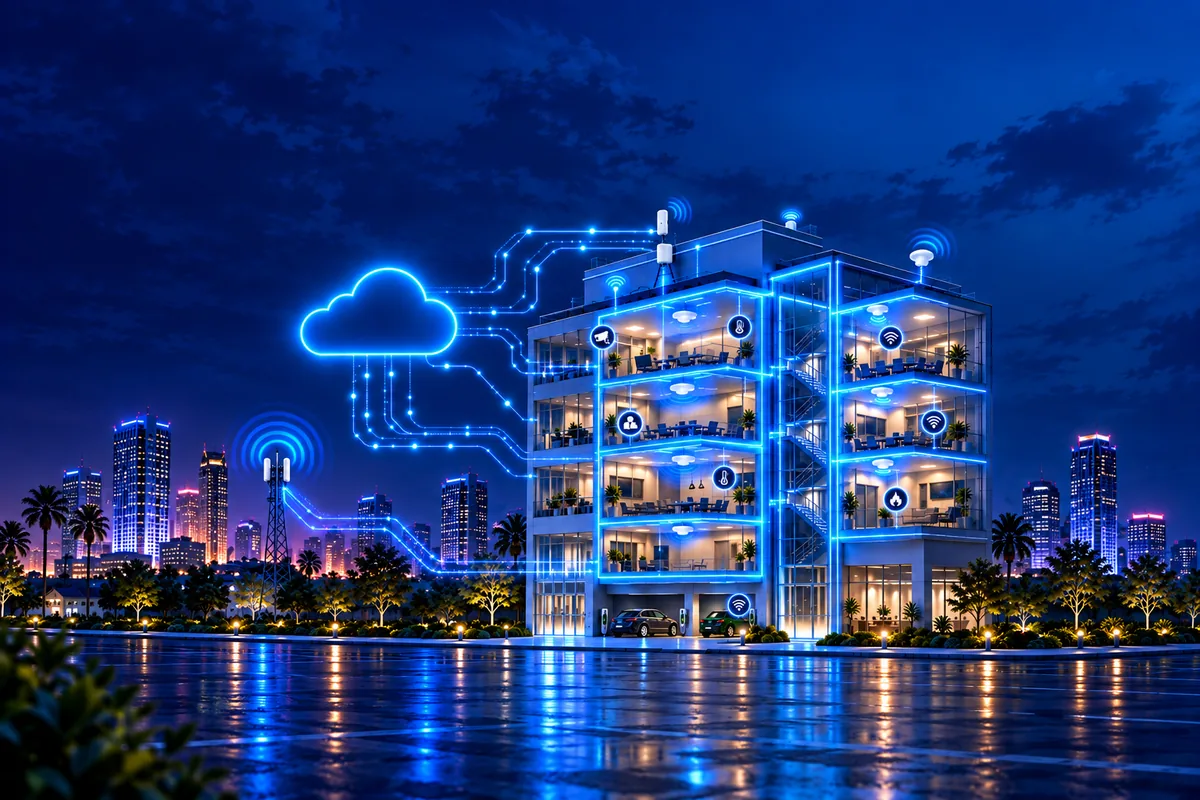
The diagram on page 3 reinforces this approach, presenting Wi-Fi, public cellular, public safety, and private wireless/IoT as complementary parts of an in-building wireless ecosystem rather than competing technologies.
Connectivity Is Also a Resilience and Security Issue
Reliable cellular coverage can also provide an important alternative to public Wi-Fi.
When cellular service is weak, users may be more likely to connect to unfamiliar hotspots or public Wi-Fi networks simply because they need connectivity. The article highlights how this behavior can increase cybersecurity exposure and argues that connectivity and cybersecurity should not be considered separately.
A properly designed public or private cellular network provides a separately managed communications path that does not rely on the building’s Wi-Fi infrastructure. While cellular networks are not immune to cybersecurity risks, maintaining more than one viable communications path can improve overall resilience when a network is unavailable, impaired, or untrusted.
Public Safety Requires Separate Consideration
Emergency responder communications add another important layer.
The authors emphasize that public-safety communications should be evaluated independently from commercial cellular and enterprise Wi-Fi. Stairwells, basements, parking structures, and other challenging areas may require particular attention, and strong commercial coverage should not automatically be assumed to satisfy emergency communications requirements.
Wireless Performance Goes Beyond Signal Strength
Seeing bars on a phone is only part of the story.
The article identifies four factors that should be considered when evaluating an in-building wireless environment:
- Coverage: Can users connect where they need to?
- Capacity: Can the network support the expected number of users and devices?
- Reliability: Does performance remain consistent over time?
- Resilience: Can important communications continue when normal systems or conditions are disrupted?
A building can therefore show acceptable signal strength and still have a network that struggles with high user density, inconsistent performance, or a lack of backup communications paths.
Start With the Requirement, Not the Product
Perhaps the most important recommendation in the article is to understand the building before choosing the technology.
Building owners, consultants, and integrators should consider the facility’s size and layout, construction materials, indoor and outdoor signal levels, existing dead zones, user density, device types, carrier requirements, operational systems, IoT applications, and future needs.
Only then should the appropriate deployment approach be selected. Depending on the environment, that could include Wi-Fi optimization, cellular signal extension, distributed antenna systems (DAS), small cells, private wireless, or a combination of technologies. Different environments—from hospitals and hotels to warehouses, offices, and data centers—may require very different solutions.
The ultimate goal is no longer simply to get a signal. It is to provide the right connectivity for the right application, in the right place, when it is needed.
As the article concludes, Wi-Fi connects people to the building’s network, while in-building cellular helps keep them connected to the outside world. Increasingly, modern buildings need both.
That is the difference between having Wi-Fi and being wirelessly ready.
Read the full article: Beyond Wi-Fi: The Wireless Readiness Gap in Modern Buildings